
 Custom bag partner
Answer first
A Flat Pocket Added to a Panel
The pocket piece lies against the outside or inside of a bag panel. Its sides and bottom are joined to that panel, while the finished upper edge remains open for access. The term describes this basic arrangement, not a particular fabric, closure, dimension or stitch specification.
A flat patch pocket is often considered for slim items. That does not mean every card, phone or accessory will fit: the opening, pocket size, material and location all matter. For the join itself, our bag seam guide explains why a visible stitch line cannot tell you everything about construction.
Choose the shape for the contents
Flat, Pleated and Gusseted Pockets Are Different Briefs
A flat patch pocket starts close to the bag panel. If the intended contents push it outward, a pleat or an added side-and-base gusset may be worth discussing instead. Those shapes introduce room for bulk, but also change the pocket's outline, how it attaches and how the front panel looks when filled.
There is no universal capacity or load figure for any of these shapes. The material, measurements, attachment and position must be considered together. A gusset creates depth; whether that depth is appropriate for a particular pocket is a sample decision, not something a product photo can settle.
Before approval
What to Confirm on the Prototype
- Name the contents: list the items the pocket should hold and bring the real items, or accurate size references, to the sample review.
- Mark the position and opening: show the pocket on the intended bag panel, its top-edge height and how a hand will reach it when the bag is worn or carried.
- Agree the edge and attachment: specify the visible top-edge finish and which sides are joined. Ask to see how the pocket meets nearby seams, straps or closures.
- Try the filled sample: insert the intended contents, then check access, panel shape and whether the bag still works as planned. If the pocket needs more room, compare a pleated or gusseted sample before approving the change.
A useful sample request: “Please show a flat pocket at this marked position and check it with these items. If it pulls the panel out of shape, show us a pleated or gusseted option for comparison.”
The sample guide covers the wider prototype review, and the bag brief guide helps record the chosen pocket position and details.
Apply this guide to a catalog style
Turn a visible bucket-tote pocket into a construction brief
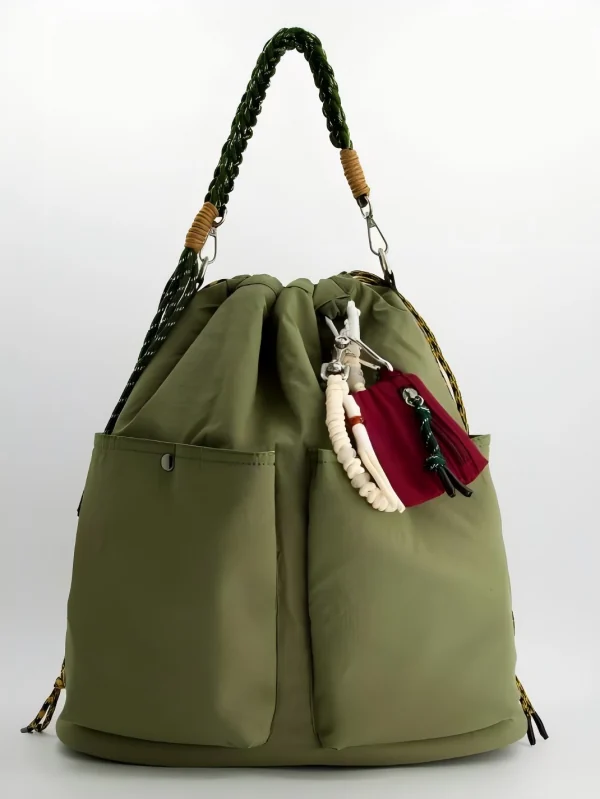
AltusPack catalog style · AP-R3-030
Custom Nylon Bucket Tote Bag with Button Closure and Oversized Pockets
What the photo shows: The photo shows two prominent exterior pocket areas on the bucket tote.
How to use this example: Use the visible pocket position to request a drawing of the opening, finished top edge and attachment path for your version. Compare a flat patch prototype with a pleated or gusseted option using the real items it must hold.
Evidence limit: The photograph does not prove the pictured pockets are flat patch pockets or show their hidden joins or capacity.
Source and limits
Where the Pocket Terms Come From
Ann Saunders, Design, Manufacture and Sell Your Bag Collection (first published 2024), Chapter 9, PDF pp. 220-222, defines flat patch pockets with a finished top edge and contrasts them with pleated and exterior gusseted pockets. The chapter also recommends modelling a pocket on a prototype rather than drawing its outline alone. This is construction guidance, not a test of a current AltusPack product or a universal capacity, strength, cost or manufacturing claim.