
 Custom bag partner
Answer first
A Seam Joins Material Pieces
Look for the point where a front panel meets a side panel, a pocket is attached to the body, or a base meets the rest of the bag. Those joins are seams. They help establish the bag's shape, and their appearance depends on how the material edges are brought together and finished.
A row of topstitching can emphasise a seam, hold an edge down or serve another design purpose. Seeing stitches on the outside does not prove that the visible row is the only structural join. Conversely, a turned bag can hide its joining stitches from the outside. For dimensions such as side depth, see our gusset guide; the measurement question is different from how the join is made.
How the join appears
Visible and Hidden Seams Have Different Edges
Turned: pieces are stitched with their outer faces together, then turned so the join is inside. This route depends on material that can turn without unacceptable cracking or distortion; the outside may show little or no joining stitch.
Raw-edge and butted: a raw-edge construction leaves cut edges and seams exposed for a deliberate look, with edge finishing to consider. In a butted construction, edges are turned over and joined with a visible seam. The exact edge treatment changes with the material; a method that suits leather or PU is not automatically suitable for a woven fabric.
Bound or piped: binding tape can enclose an exposed edge, particularly where the chosen material may fray. Piping adds a raised line along a seam and can define the bag's outline. Neither a neat binding nor a prominent piped line tells you the hidden join, its allowance or its strength from a photo alone. Our trims guide covers binding and other visible components in the wider brief.
Before approval
What to Check on a Bag Prototype
- Mark every important join: note the body, gusset, base, pockets, handle attachments and openings on a drawing or reference photo. Say which lines should be visible and which should be hidden.
- Confirm the edge finish: ask for the selected material and actual treatment of exposed or enclosed edges, especially around curves and corners. Do not assume the same finish works for every material.
- Inspect the assembled bag: look at both faces where possible, follow the seam through bends and pocket corners, and check whether the bag keeps the intended shape when handled and filled for its proposed use.
- Agree any performance check: a clean-looking line does not establish seam strength or long-term wear. Define the relevant load and test method for the exact construction if a performance claim is needed.
A useful sample request: “Please mark the joins at the pocket, base and handle. Show which edges are turned, exposed or bound, and let us review the finished bag before approving the construction.”
Use the sample guide for a wider prototype review and the bag brief guide to record the agreed construction.
Apply this guide to a catalog style
Ask for both sides of the join on a bucket tote
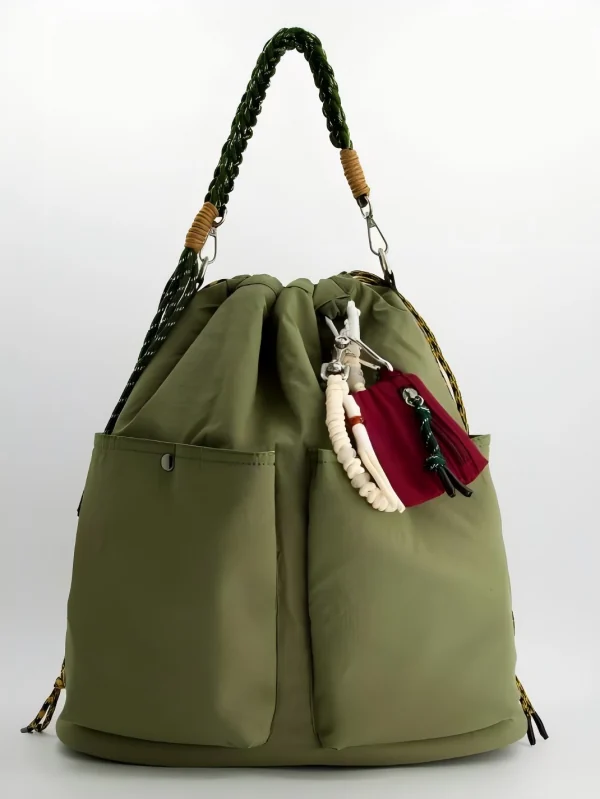
AltusPack catalog style · AP-R3-030
Custom Nylon Bucket Tote Bag with Button Closure and Oversized Pockets
What the photo shows: The photo shows exterior pocket edges, a lower bag edge and handle connections.
How to use this example: Mark the pocket-to-body join and base join on this style, then request close-up views of the outside and inside of the proposed sample. Record the specified seam and edge finish for each join instead of relying on one front photo.
Evidence limit: The photo cannot reveal the full stitch path, seam allowance, inner finish or strength.
Source and limits
Where the Construction Terms Come From
Ann Saunders, Design, Manufacture and Sell Your Bag Collection (first published 2024), Chapter 8, PDF pp. 196-198, describes joining bag materials by stitching, turned, raw-edge and butted construction, and featured binding and piped seams. The book explains these forms and their material-dependent limitations; it does not verify a current AltusPack method, universal strength ranking, fixed seam allowance, production cost or the performance of a finished order. Confirm the actual material, join and any agreed test on the proposed sample.