
 Custom bag partner
Answer first
The Pattern Begins in the Yarn
Both the textile textbook Textiles and the FIT Fashion History Timeline describe yarn sections being bound against dye before weaving. Once the ties are removed, the dyed and undyed parts of the yarn can be arranged to form the woven design. That sequence is the useful distinction when someone says a bag is made from ikat fabric; the visible zigzag or softened edge alone does not identify the process.
Warp ikat uses the lengthwise yarn set, weft ikat the crosswise set, and double ikat both. These are process descriptions, not a promise about fibre, place of origin, handwork, colourfastness or price.
Original process sketch
Tie and Dye the Yarn Before Weaving
If the pattern is instead printed onto already woven fabric, the design can be visually reminiscent of ikat but the colour was not arranged in the yarn before weaving. Our bag decoration Guide discusses surface application as a separate decision; a surface-print method does not become ikat weaving because the motif resembles it.
Name the option honestly
Woven Ikat or an Ikat-Inspired Print?
For a bag brief, either aesthetic direction could be discussed, but they should be named differently. If woven ikat is required, ask the fabric supplier for its yarn-resist process description, fibre and construction details, article code and a physical swatch. If the goal is only the visual motif, an ikat-inspired print is a different proposal whose colour placement and sample need separate approval. A blurred edge in a photo, or a quick look at the back, is not enough to authenticate the weaving process.
We can help position a supplied swatch on a proposed bag shape and review the panel layout. If there is no verified fabric source yet, we may need to pause any material-specific promise while the textile and sample are confirmed. The bag-material Guide
A useful message to send: “I like this patterned-bag direction. Is actual yarn-resist-dyed woven ikat essential, or is an ikat-inspired print acceptable? I can share a fabric swatch or supplier article so we can check placement on the bag sample.”
Adjacent tote shape
This Tote Is a Layout Reference, Not Ikat Cloth
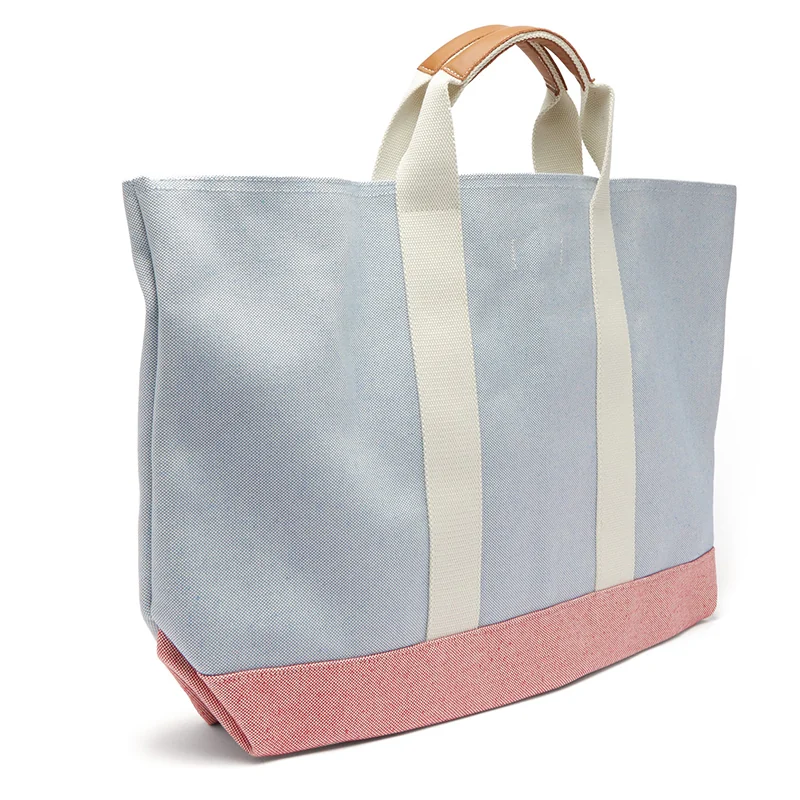
AltusPack catalog style · AP-R3-032
Custom Waxed Canvas Beach Tote Bag with Zipper Closure
What the photo shows: A broad front panel, long handles and a contrasting lower band.
How to use this example: Its large panel gives a shape on which to discuss where a supplied pattern would fall.
Evidence limit: This photo and catalog title do not establish ikat, a printed ikat look, fibre or an approved patterned version of this bag.
Source and limits
Process Evidence, Not an AltusPack Material Claim
Textiles, 6th ed. (1988), PDF p.352/book p.343, identifies yarn tying before dyeing and weaving, including warp, filling and double ikat. The FIT Fashion History Timeline's ikat entry independently explains pre-weaving yarn-resist patterning. The process drawing and buyer questions are original editorial explanations; the tote image is a first-party catalog observation only. Neither source nor that image verifies an AltusPack ikat textile, supplier, weaving method or finished-bag test.