 Custom bag partner
Answer first
A Twill Fabric, Often Dyed for a More Even Colour
Current fabric sellers Canvas ETC and Big Duck Canvas describe their bull denim as cotton twill and often piece-dyed after weaving. That treatment can give a more uniform colour through the visible cloth than the familiar blue-jean look. Their examples help explain the term, but neither seller's range sets a compulsory composition or dye process for every product sold as bull denim.
Twill is the diagonal interlacing structure. Piece dyeing describes colouring the woven cloth. One term does not establish the other. If a supplier says “3×1 twill,” that is its weave detail; it is not an automatic strength or care result for your finished bag.
Compare the right feature
Bull Denim vs Conventional Blue-Jean Denim
Conventional blue-jean denim is commonly described with indigo-coloured warp yarns and a pale or undyed filling, making the two faces and fading pattern distinctive. In the suppliers' bull-denim descriptions, the cloth is often woven first and then dyed as a piece, giving a more even, solid-looking colour. Both can be twills, so a diagonal rib alone is not enough to identify which you are holding.
That is a commercial distinction rather than a guaranteed rule for every mill or colourway. The current supplier swatch and specification should resolve edge cases. Our plain-and-twill Guide explains the diagonal weave itself; the fabric-naming Guide shows why retail names should not replace construction details.
For a bag-material request
Ask for the Specific Cloth, Not Just “Bull Denim”
We can compare a bull-denim candidate with your reference bag once we know the intended shape, colour and care expectations. The key unknown is the actual supplier article. For example, Big Duck Canvas lists particular fabrics with a stated 12 oz weight and different 56- or 58-inch widths; those are its individual listings, not a universal bull-denim weight or width.
- Request supplier name and article code, fibre composition and weave construction.
- Record finished weight, nominal and usable width, dye and any finish or preshrink treatment.
- Ask for that article's care instructions and a physical swatch rather than borrowing advice from another seller.
- Assess the sewn bag sample for shape, colour and seam behaviour before approving the material.
A useful message to send: “I want the more even colour associated with bull denim on this tote. I have a supplier swatch and article number. Can we compare its hand, weight and care information with a regular denim option before sampling?”
A seller's wash or shrinkage claim for its own cloth does not make an untested custom bag machine-washable. The broader bag-material guide covers other fabric-selection fields.
Adjacent denim-style example
This Catalog Bag Is Not a Bull-Denim Claim
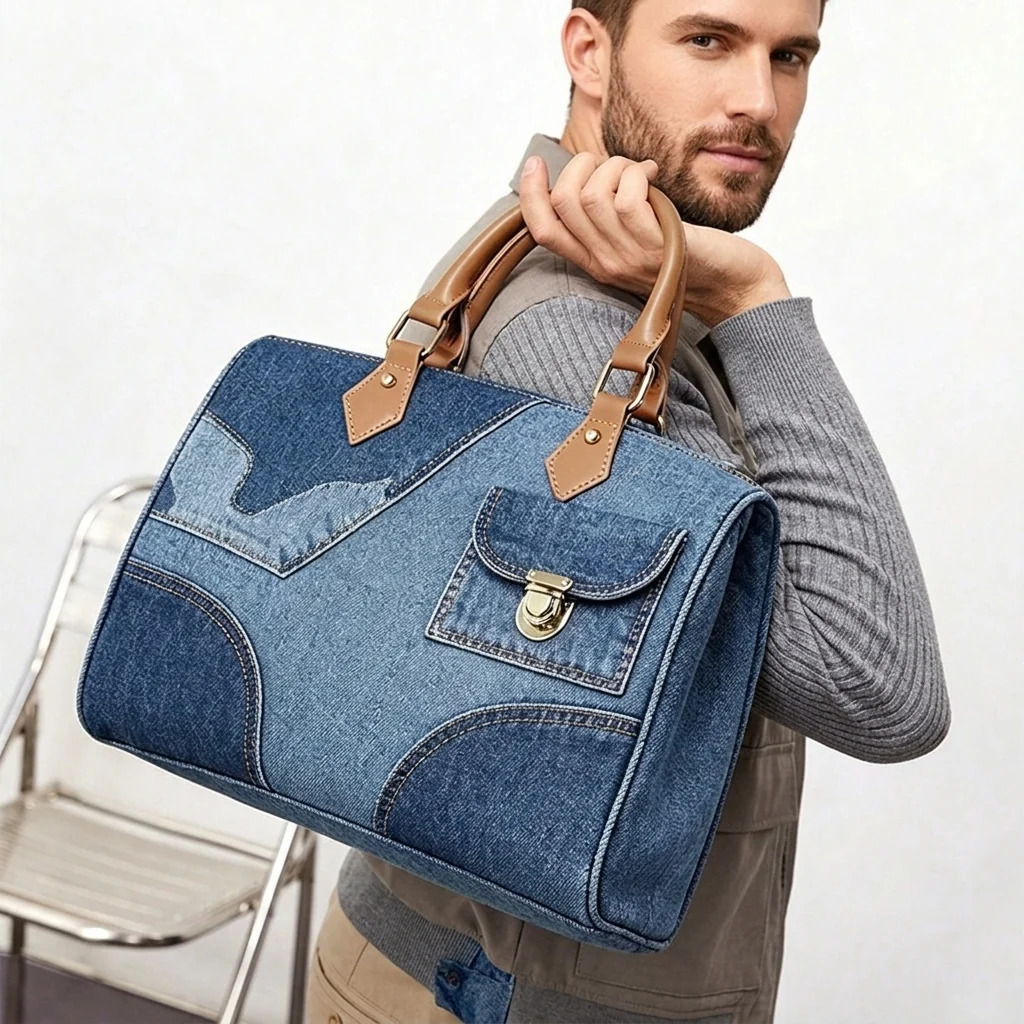
AltusPack catalog style · AP-R15-042
Custom Denim Tote Bag
What the photo shows: Blue patchwork-style panels, a front pocket, visible seams and tan handles.
How to use this example: If you like the shape but want a more uniform colour, specify the candidate bull-denim swatch and ask how the panels would look in that exact cloth.
Evidence limit: The catalog name and photo do not verify bull denim, fibre composition, dye method, weight, care or wear performance for this style.
Source and limits
Supplier Examples, Not a Universal Standard
Canvas ETC's bull-denim explainer and Big Duck Canvas's current range support a bounded twill-and-colour comparison. Their cotton percentages, 3×1 construction, widths, weights and care claims describe their own offerings. The bag-material questions here are AltusPack editorial advice. No AltusPack bull-denim SKU or finished-bag test is verified by those pages.