
 Custom bag partner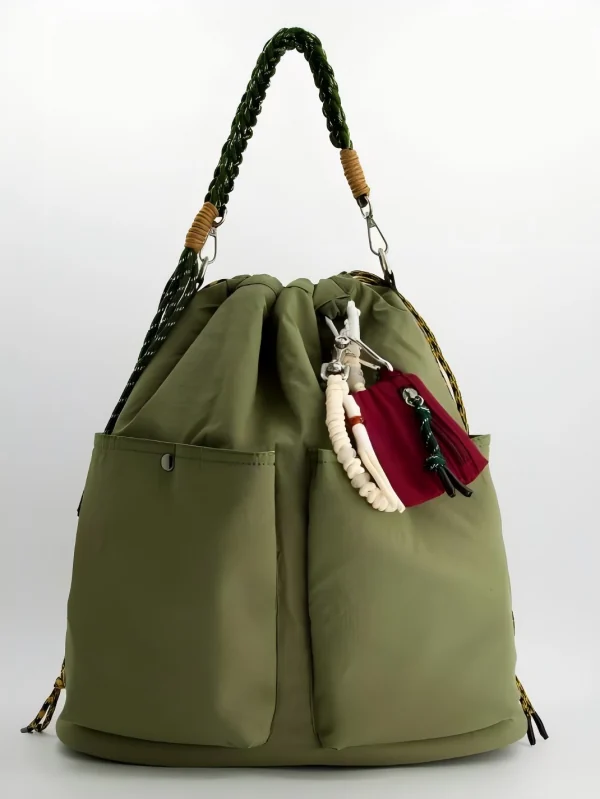
Answer first
Mass per Area, Not the Weight of a Whole Bag
If a finished fabric is specified as 300 GSM, one square metre of that same fabric has a nominal mass of 300 grams in the specified test state. The area is part of the unit. A small swatch has less total mass because it contains less area; a completed bag also includes lining, handles, zippers, hardware and other pieces.
Record whether the quoted number applies to the base cloth or to a coated, backed or laminated finished material. A fabric weight without the exact material code and specimen state is easy to compare incorrectly.
Read the unit
GSM and oz/yd² Measure Mass per Area
GSM is g/m²; oz/yd² includes both the ounce mass and the square-yard area. The cited textile-testing appendix gives 1 oz/yd² ≈ 33.906 g/m². Thus a fabric specified at 10 oz/yd² is about 339 g/m² after rounding. This converts units for the same fabric state; it does not turn ounces of a whole swatch into GSM.
Denier is different
Denier is mass per length of yarn: grams per 9,000 metres. It cannot be converted to finished-fabric GSM without knowing how yarns, construction and finishing make up the cloth. The denier guide covers that yarn-level question.
Thickness is different
Thickness is a distance, and a contact measurement can change with pressure on the fabric. Two materials with the same GSM can differ in structure, thickness and feel. Neither number alone gives a strength or quality grade.
Before sampling
What to Confirm in a Bag Fabric Brief
- Identify the exact material: request the supplier's fabric code, fibre content, construction, finish and a swatch. State whether GSM or oz/yd² includes coating, backing or other layers.
- Keep units and objects separate: write the fabric's mass per area with its unit; record swatch dimensions and total mass separately if those are supplied. Ask for finished-bag mass as a separate product measurement.
- Compare like with like: use the same finished state and agreed conditioning or test method when comparing options. Ask for sample and test evidence if thickness, strength, wear or water-related performance matters.
- Check the prototype: review how the chosen shell, lining, pockets, handles and trims work together. GSM by itself does not predict the assembled bag's form or performance.
A useful request: “Please send the exact fabric code and finished GSM or oz/yd², confirm which layers are included, and provide a swatch. List thickness and any performance results separately with their measurement conditions.”
Use the bag materials guide for the wider shell and lining decision, and the sample guide for the finished prototype review.
Shape reference
See Where a Fabric Specification Applies
The bucket tote reference shows body panels, large exterior pockets and a handle. Its photo can help identify which parts need separate material specifications. It does not establish the pictured product's GSM, fibre specification, thickness, strength or finished mass.
Source and limits
Where the Unit Distinctions Come From
B. P. Saville, Physical Testing of Textiles (1999), Appendix, PDF p. 324, lists the rounded oz/yd²-to-g/m² conversion and distinguishes ounce mass from mass per area. Chapter 4, PDF p. 95, defines denier as yarn mass per length; Chapter 10, PDF pp. 283-285, explains why contact-measured thickness depends on pressure. These are unit and testing principles, not current supplier specifications, a current testing-standard claim or proof of bag performance. Confirm the offered fabric and assembled product separately.